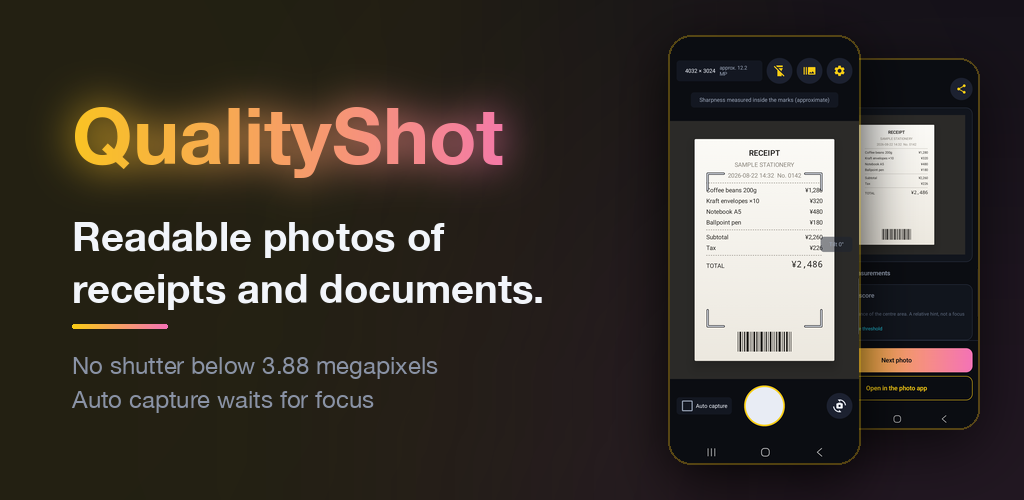
Made for photos you will need to read later, such as receipts.
While the output is below 3.88 megapixels, the capture button stays disabled. After each shot, the app records the output pixels, output format, tone levels in use and sharpness score, and you can share them with the photo. A stack of receipts can be shot in one go with continuous capture.

Features
Nothing extra. It keeps unreadable photos from being taken, and records measurements after each shot.
When the app opens, it checks how many pixels will actually be delivered. Below the requirement, the capture button stays disabled, and the screen shows why.
After you press the shutter, nothing is taken until the sharpness in the middle of the frame reaches the threshold. It never settles for a weaker shot when time runs out. Press again to stop.
Instead of moving to the result screen after each shot, the app goes straight back to being ready for the next one. The resolution check and the measurements for each photo stay the same.
The volume keys also work as a shutter, so you can hold the paper down while you shoot. When it is dark, turn on the light from the capture screen.
The device tilt is shown as a number. The area where sharpness is measured can be shown as a frame if you turn it on in Settings. Both are display only and do not change what is recorded.
The output format is JPEG (8 bits per channel). On top of that, the app measures how many of the 256 levels are actually used in each of R, G and B. The value depends on the subject, so it is not used to judge quality.
A hint for checking focus, calculated from the high-frequency detail in the middle of the frame. It means little for subjects with few clues, such as blank paper, so the app shows "Undetermined" for them.
Send the photo together with a summary of its measurements through Android's share menu. The recipient can also see what resolution the photo was taken at.
No server, no account. Sharing happens only when you do it. The ad SDK (Google AdMob) does use the network.
No in-app purchases, no feature limits, no trial period. Ads appear only on the result and settings screens, never on the capture screen.
How it works
Open the app and the resolution check begins.
As soon as it starts, the app checks the current output resolution. While the requirement is not met, the shutter stays disabled and the reason is shown.
You can capture only when the output is 3.88 megapixels or more. The shutter works with the on-screen button or the volume keys. With Auto capture on, the app waits after you press it until the sharpness in the middle of the frame reaches the threshold, then shoots automatically.
Pass the photo on to wherever your expense claim goes, with four items attached: output pixels, output format, tone levels in use and sharpness score. While Continuous capture is on, this screen is skipped and you go straight back to the next shot.
Notes
Better to tell you up front what the app does not do than to have you find out later.
If the device falls short of the requirement, that camera cannot capture. On some models the front camera falls short.
The app goes as far as leaving a photo that can be read later. Use your usual apps to read or submit it.
Tilt is shown as a number while you shoot, but the image is not corrected afterwards, because it would no longer match the recorded measurements.
How the value comes out depends on the model and the subject. Use it as a relative hint under the same conditions.
Both lower the score in the same way. The final call is yours.
It is a measured value that varies with the subject. A smaller number does not mean lower image quality.
There is no capture history, so sharing with measurements is done from each photo's result screen. During continuous capture, a short notice tells you each photo was saved, and adds a note when focus may be soft or sharpness could not be judged.
The receiving app may re-compress the image. What happens from there is out of the app's hands.
Requires Android 8.0 (API 26) or later